
In chocolate production, melting is not just a preliminary step. It directly affects viscosity, tempering stability, surface gloss, snap, and the consistency of the final production process.
Although melting chocolate may appear simple, poor temperature control can lead to overheating, increased viscosity, damage to milk solids, and problems later during tempering or molding.
The correct melting method depends on production volume, required temperature precision, workflow efficiency, and the specific chocolate being processed.
Recommended Chocolate Melting Temperatures
| Chocolate Type | Typical Melting Range |
|---|---|
| Dark Chocolate | 45–50°C |
| Milk Chocolate | 40–45°C |
| White Chocolate | 38–42°C |
These temperatures should be treated as general starting points rather than universal rules. The recommended melting temperature can differ between manufacturers and even between couvertures from the same brand.
Some chocolates are processed at temperatures around 45°C, while manufacturers may recommend temperatures of 50–55°C for other products. When a manufacturer provides a specific tempering curve, it should normally take priority over a generic temperature table.
Milk and white chocolate are particularly sensitive to excessive heat because they contain milk solids and higher proportions of heat-sensitive ingredients. Overheating can contribute to flavor deterioration, thickening, graininess, and poor processing characteristics.
Why Melting Temperatures Differ Between Chocolates
Chocolate does not have one universal melting temperature. Its behavior depends largely on the composition of its fat phase — especially cocoa butter — as well as the complete formulation and manufacturing history of the chocolate.
Cocoa butter is a mixture of different triglycerides. Their proportions can vary according to cocoa genetics, growing conditions, origin, and processing. This influences how the fat crystallizes and the temperature range over which its crystalline structure melts.
The finished chocolate adds further variables. Cocoa butter content, cocoa solids, sugar, milk fat, emulsifiers, additional fats, and other ingredients can all affect its thermal and rheological behavior.
Melting Is About Resetting the Crystal Structure
Before chocolate can be tempered predictably, the existing cocoa butter crystal structure must be sufficiently melted.
The objective is not simply to make the chocolate look liquid. The chocolate needs to reach a condition from which controlled crystallization can begin again during tempering.
This distinction is important in production: chocolate can appear completely fluid while remnants of existing crystal structures may still influence subsequent crystallization.
Origin and Processing Matter
The behavior of cocoa butter begins with the raw material itself. Cocoa genetics, climate, fermentation, drying, and subsequent processing all contribute to the properties of the final cocoa ingredients.
Manufacturing decisions then add another layer. Refining, conching, cocoa butter treatment, emulsifier selection, recipe formulation, and storage conditions can influence viscosity, crystallization behavior, and the practical temperature curve of the finished couverture.
This is why two dark chocolates with the same stated cocoa percentage do not necessarily behave identically in a melter or tempering machine.
What About Lecithin and Conching?
Lecithin is primarily used to modify the flow properties of chocolate. It can reduce viscosity and improve processing behavior by influencing interactions between the fat phase and solid particles.
Conching also affects the final behavior of chocolate by changing moisture content, flavor development, particle coating, and rheology. Time and temperature during conching therefore contribute to how the finished chocolate behaves during subsequent production.
These factors should not be considered independently. The practical melting and tempering curve is the result of the complete product formulation and manufacturing process.
There Is No Universal Temperature Curve
The most reliable approach is therefore to treat generic melting temperatures as a reference and the chocolate manufacturer's technical recommendations as the primary process specification.
If one couverture is recommended to be melted at 45°C and another at 50–55°C, this does not necessarily mean that one is more delicate or higher quality than the other. It means their formulations and processing requirements are different.
For professional production, record the actual temperature curve used for each chocolate. This makes the process repeatable when changing batches, operators, recipes, or production volumes.
1. Bain-Marie (Double Boiler)
Best for: Home use and very small batches
Typical capacity: 0.5–2 kg
The bain-marie is the most common beginner method for melting chocolate. A bowl containing chocolate is placed above simmering water, allowing indirect heat to melt the product gradually.
In practice, process control is difficult. If the bowl is exposed to excessive heat, localized overheating can occur, which is particularly problematic with milk and white chocolate.
Another major risk is moisture contamination. Even a small amount of water can cause chocolate to seize and dramatically increase its viscosity.
- Keep the bowl above the water rather than immersed in it
- Stir continuously
- Avoid steam contact
- Ensure all tools are completely dry
- Monitor the actual chocolate temperature with a thermometer
While this method is acceptable for hobby use or very small batches, it becomes inefficient and difficult to standardize in professional production.
2. Microwave Oven
Best for: Small batches, decorations, test samples
Typical capacity: 0.2–1 kg
Microwaves offer fast and convenient melting but provide uneven heat distribution.
Localized hot spots can develop quickly, meaning one section of the chocolate may overheat while another remains solid.
- Heat in short 15–30 second intervals
- Stir thoroughly after every cycle
- Reduce heating time as the chocolate approaches the target temperature
- Measure the temperature after mixing, not immediately after heating
Mixing is essential because it redistributes heat throughout the mass and reduces the risk of localized overheating.
3. Oven or Combi-Steamer
Best for: Pre-melting medium and large quantities
Typical capacity: 1–10 kg
Some professionals use ovens as a low-labor solution for slowly pre-melting chocolate.
Chocolate can be placed in a heat-resistant container and held at a controlled low temperature for several hours. The exact set point should be selected according to the chocolate being processed rather than automatically using the same temperature for every couverture.
In combi-steamers, the steam function must be completely disabled. Moisture contamination can cause serious problems with chocolate flow and processing.
Additionally, oven temperature and airflow may not correspond exactly to the temperature inside the chocolate mass. The chocolate itself should therefore be checked before further processing.
The method can be practical for bulk preparation but provides less direct process control than dedicated chocolate equipment.
4. Chocolate Melters
Best for: Pastry shops, confectionery labs, boutique production
Typical capacity: 1–20 kg
Professional chocolate melters are one of the most practical solutions for small and medium-scale chocolate production.
Their primary function is to melt chocolate gently and maintain a stable working temperature with minimal operator intervention.
Typical melting time may range from approximately 1 to 4 hours depending on batch size, starting temperature, equipment design, and chocolate type.
A professional melter should provide controlled, evenly distributed heating and stable temperature maintenance. This becomes particularly important when the same chocolate must behave consistently from batch to batch.
Professional systems may use digital temperature controllers, distributed heating elements, insulated tanks, and food-grade stainless steel construction.
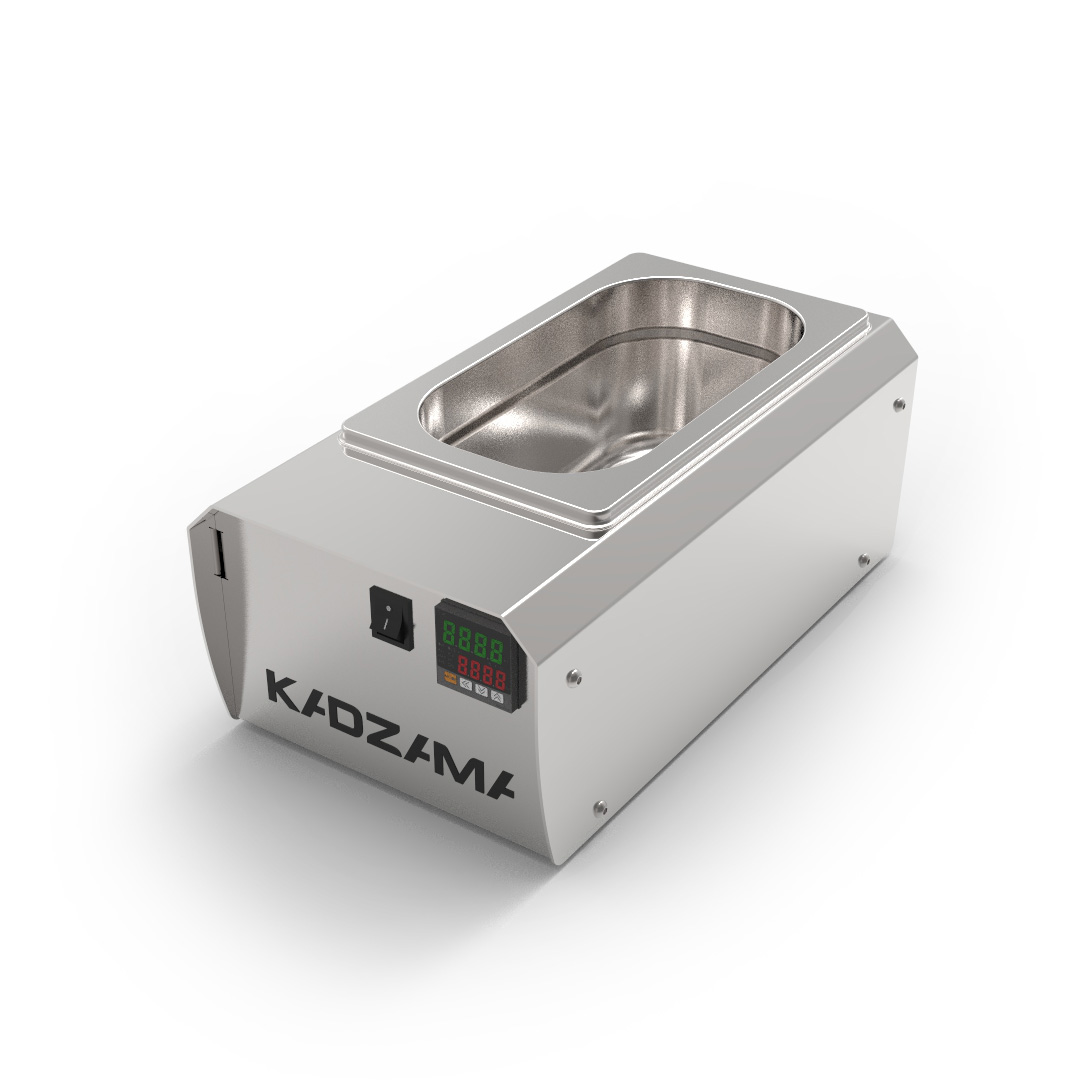
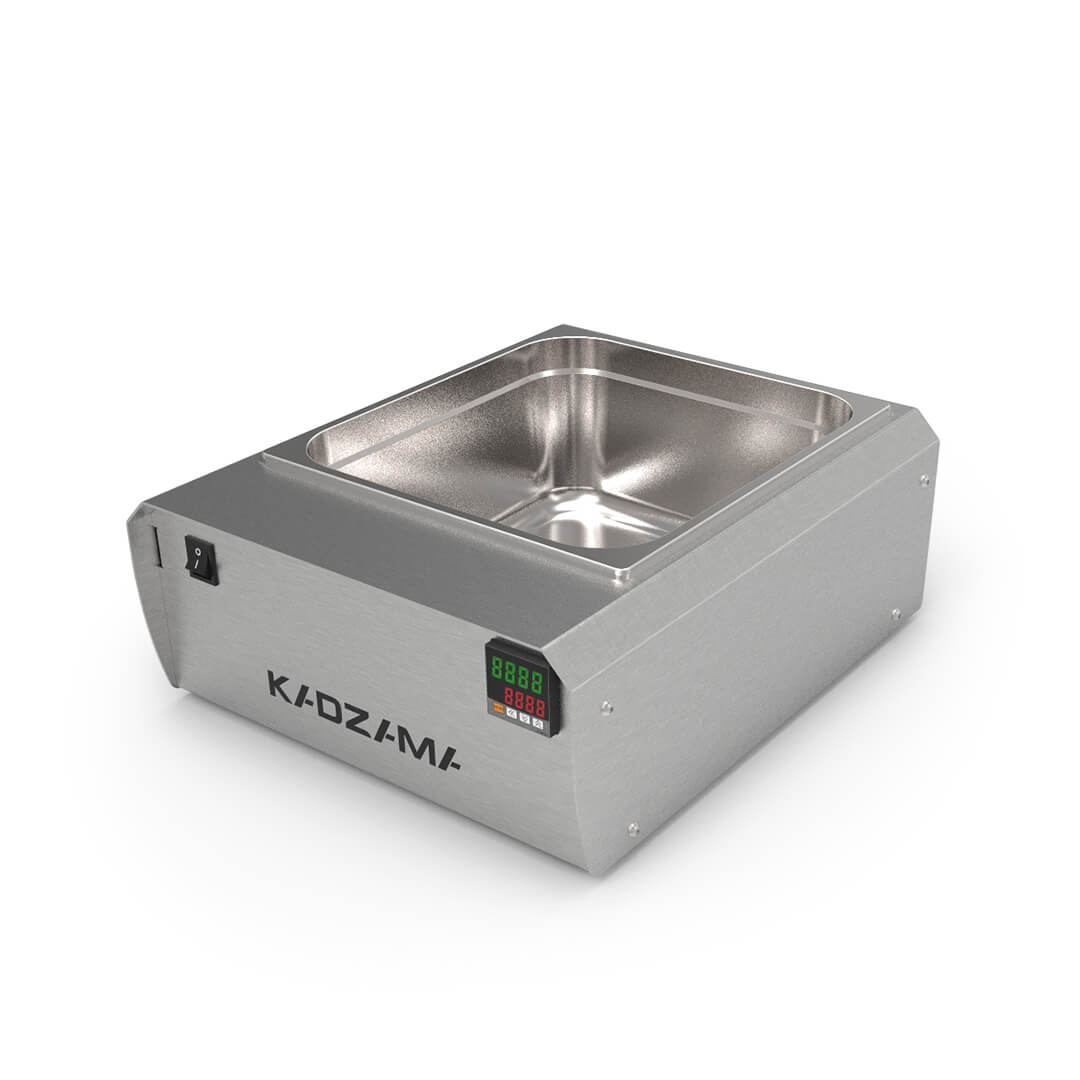
In KADZAMA chocolate melters, infrared heating is used to transfer heat gently to the container and chocolate, helping reduce localized overheating and supporting stable temperature control.
Stainless steel is widely used in professional equipment because it:
- Resists corrosion
- Simplifies cleaning
- Meets professional food-processing requirements
- Provides a durable working surface
Depending on the production process, additional equipment may include mixers, programmable controls, dispensing systems, or mobile frames.
5. Industrial Melting Tanks
Best for: Industrial chocolate manufacturing
Typical capacity: 100 kg and above
Industrial melting tanks are designed for large-scale chocolate processing and buffer storage.
Many systems use indirect jacket heating to distribute heat across a larger surface area and reduce the risk of localized overheating.
Continuous agitation helps maintain homogeneous temperature and consistency throughout the mass.
Once melted, chocolate can be transferred or pumped into tempering, molding, enrobing, or depositing equipment as part of a continuous production workflow.
6. Tempering Machines
Best for: Continuous production
Typical capacity: Depends on machine design and throughput
Chocolate can often be melted directly inside a tempering machine. However, using valuable tempering capacity exclusively for melting may reduce overall production efficiency.
In higher-throughput workflows, a separate melter can act as a buffer: chocolate is pre-melted and maintained at the required temperature before being supplied to the tempering system.
This allows the tempering machine to perform its primary function continuously rather than waiting for solid chocolate to melt between production cycles.
How to Choose the Right Chocolate Melting Method
| Production Scale | Recommended Method |
|---|---|
| Home use / testing | Bain-marie or microwave |
| Small pastry shop | Chocolate melter |
| Boutique chocolate production | Professional melter |
| Continuous production | Melter + tempering machine |
| Industrial manufacturing | Melting tank + tempering system |
The goal is not simply to turn solid chocolate into liquid chocolate. A professional process should provide controlled heating, repeatable temperatures, sufficient capacity, and a predictable transition to the next production stage.
Practical Rules for Melting Chocolate
- Check the manufacturer's recommended temperature curve for the specific chocolate.
- Do not assume that every dark, milk, or white chocolate requires exactly the same temperature.
- Measure the temperature of the chocolate mass, not only the equipment set point.
- Mix the chocolate to equalize temperature throughout the batch.
- Avoid unnecessary overheating once the chocolate is completely melted.
- Keep water and steam away from chocolate.
- Record working parameters for frequently used couvertures to make production repeatable.
Final Thoughts
Chocolate melting is a technological stage that directly influences everything that follows.
There is no single perfect melting temperature for every chocolate. The commonly quoted ranges for dark, milk, and white chocolate are useful starting points, but the correct temperature ultimately depends on the formulation and manufacturer's recommendations for the specific product.
At the same time, equipment matters. The larger the production volume, the more important controlled heat distribution, temperature stability, and repeatability become.
For professional production, the best approach is to combine the correct temperature curve for the chocolate with equipment capable of maintaining that curve consistently from batch to batch.
If you want to learn how to choose a professional chocolate melter and avoid common purchasing mistakes, read our guide: How to Choose a Chocolate Melter.

 Sending...