
A good chocolate melter does more than heat chocolate. It must hold a stable working temperature, heat evenly, and reduce the risk of moisture, overheating, and constant manual correction. When comparing models, focus on five things: heating method, temperature control, moisture risk, tank configuration, and build quality. Extra features only matter if they make your process more stable or more efficient.
Why the wrong melter creates real production problems
Chocolate melting looks simple, but this is where many quality issues begin. If heat is uneven or temperature drifts too far, cocoa butter crystals become unstable. The result is not just inconvenience. You can end up with dull surface finish, poor snap, thickened mass, or inconsistent moulding performance.
That is why choosing a melter is not only about convenience. It affects three practical outcomes:
- temperature stability
- batch repeatability
- operator time spent on monitoring and correction
A useful melter should help you keep chocolate in range without constant intervention.
1. Heating method: how the machine transfers heat matters
When manufacturers say a melter offers temperature control, the real question is how heat is delivered to the chocolate.
Chocolate needs controlled, even heating. If the base or walls overheat before the full mass reaches working temperature, you create local hot spots. That can damage texture and make tempering less predictable.
Recommended temperature ranges
| Chocolate type | Melt at | Work at |
|---|---|---|
| Dark | 45–50°C | 31–32°C |
| Milk | 40–45°C | 29–30°C |
| White | 40–45°C | 28–29°C |
Infrared heating
Infrared heating is often preferred because it transfers energy more directly and can respond faster than indirect systems. In practice, that may help improve temperature stability and reduce overshooting.
But the label alone is not enough. Before buying, check:
- how the heating elements are positioned
- whether heat is distributed across the full surface
- where the thermocouple or sensor is placed
- whether the sensor measures the chocolate itself, especially near the bottom of the tank
If the sensor reads the housing rather than the product mass, the display may look stable while the chocolate is not.
Bain-marie systems: the hidden moisture risk
Many confectioners start with bain-marie melters because water-jacket heating is seen as gentle. The problem is not the idea of gentle heating. The problem is moisture.
In a bain-marie system, water and steam are part of the heating process. If condensation forms and even a small droplet enters the chocolate, the mass can seize. Sugar binds the moisture, and the chocolate thickens into sticky clumps very quickly.
That means the main question is not whether bain-marie is traditional. It is whether the design minimizes water contact risk.
Check:
- lid sealing
- condensation around rims and covers
- ease of cleaning and inspection
- whether the construction keeps moisture away from the product zone
For chocolate, avoiding water is often more important than choosing the softest possible heating concept.
2. Temperature control
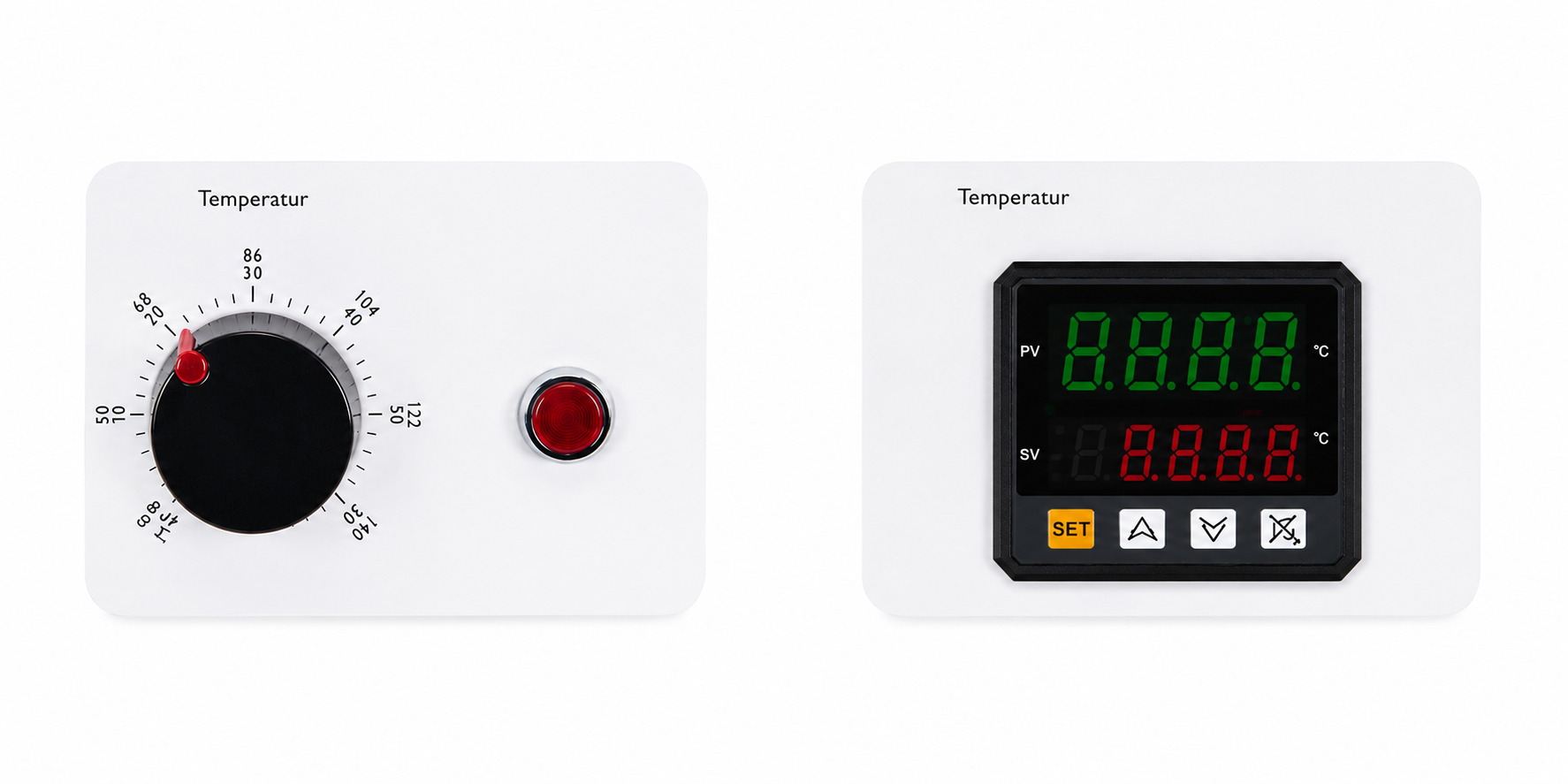
A melter with a simple control knob can still melt chocolate, but it puts more responsibility on the operator. You need to watch the product, measure the mass, and make manual corrections.
A more advanced unit uses a sensor and automatic feedback to adjust heating continuously. That matters when you want repeatable results across shifts, products, or operators.
When comparing units, ask:
- does the machine measure actual product temperature
- where is the sensor located
- how does the system respond to deviation
- what temperature accuracy does the manufacturer specify
If that information is missing, it becomes harder to judge whether the unit can truly hold a working range.
4. Single tank or double tank
A double-tank melter is useful if you work with two chocolates at once, such as dark and milk. It can reduce downtime and make product changeovers easier.
But there is one critical condition: each tank should have independent temperature control.
Dark, milk, and white chocolate do not run at the same working temperature. If two tanks share one control, one side may be too hot while the other remains below target. That creates inconsistency instead of flexibility.
5. Materials
Material choice affects hygiene, durability, and heat stability.
For food safety, stainless steel is the gold standard — specifically high-grade 304 or 316 for the tank, paired with a heavy-duty, heat-resistant housing. It's non-reactive, non-porous, and incredibly durable. Plus, a thick-bottomed design acts like a thermal mass, holding heat steadily instead of letting it escape.
Lower-end melters often cut corners with thin plastics or very lightweight metals that can't handle constant heat cycles. Plastic, in particular, is a poor conductor and scratches easily — and those scratches trap bacteria, compromising purity and shelf life. Aluminum itself isn't the problem; quality is. A well-made aluminum melter can perform just fine. The issue is when manufacturers use cheap, thin materials regardless of the metal type.
Which extra features are used
Built-in programs
This feature may seem very useful at first, because the operator does not need to think about which temperature to set for dark, milk, or white chocolate. It can make setup easier, especially in day-to-day work. However, the difference between working temperatures is quite small, so we would not consider this function essential by itself. It may be a convenient extra, but we are not convinced it is worth paying more for this feature alone.
External temperature probe
Some melters include an external immersion probe as an optional accessory. This probe is designed to be placed directly into the chocolate to measure its core temperature. But mostly chocolatier has pyrometers in the workspace, it can do the job just fine.
Common buying mistakes
- Choosing by price alone instead of process stability
- Assuming all heating systems perform the same
- Buying a dual-tank unit with one shared temperature control
- Ignoring cleaning and sanitation during evaluation
- Focusing on extra features before checking heating accuracy
FAQ
What is the most important feature in a chocolate melter?
The most important feature is stable, accurate temperature control in the actual chocolate mass. Without that, even a well-built machine can produce inconsistent results.
Is infrared heating better than bain-marie?
It can be, especially when fast response and precise control are important. The main advantage is process stability. Bain-marie systems can work, but they carry moisture risk if the design is poor.
Do I need a double-tank melter?
Only if you regularly work with two chocolates at the same time. If you do, independent temperature control for each tank is essential, but no every melter has set with 2 temperature sets.
Is a mixer necessary?
It is most useful in larger-capacity melters, where it helps keep texture and temperature consistent across the whole batch.
Which material is best?
For food-contact parts, stainless steel is generally preferred because it is durable, hygienic, and easier to clean.
 Sending...