
How to Start a Chocolate Business with a Mini Factory for €3,490
A small chocolate business does not need industrial-scale equipment to start producing professionally. A compact setup built around a 20 kg tempering machinecocoa butter crystal incubator and a vibrating table helps launch molded chocolate production with lower infrastructure requirements and more predictable process control.
The full equipment set normally costs €4,270, but the complete mini-factory package is available for €3,490.
In practice, this setup supports roughly 20–60 kg of chocolate per day, depending on product type, workflow, and production pace. The incubator produces 2 kg of silk in 24 hours, enough for up to 600 kg of chocolate.
Why starting a chocolate business is difficult in practice
For a small chocolate brand, the biggest problem is rarely the recipe. The real bottleneck is process stability.
If tempering is inconsistent, the surface loses gloss, the snap becomes less reliable, and molded pieces release less predictably. If filling is slow, labor costs rise and output per shift stays too low. If the equipment requires 380V, industrial ventilation, or a large dedicated production area, the business has to absorb major fixed costs before demand is proven.
This is why many founders get stuck between two bad options. They either invest too heavily in industrial equipment too early, or they start too manually and struggle to keep quality consistent from batch to batch.
A compact chocolate mini-factory solves that problem differently. It gives a workshop controlled temperature handling, faster molding, and a practical production volume without forcing factory-scale overhead from day one.
What this mini-factory includes
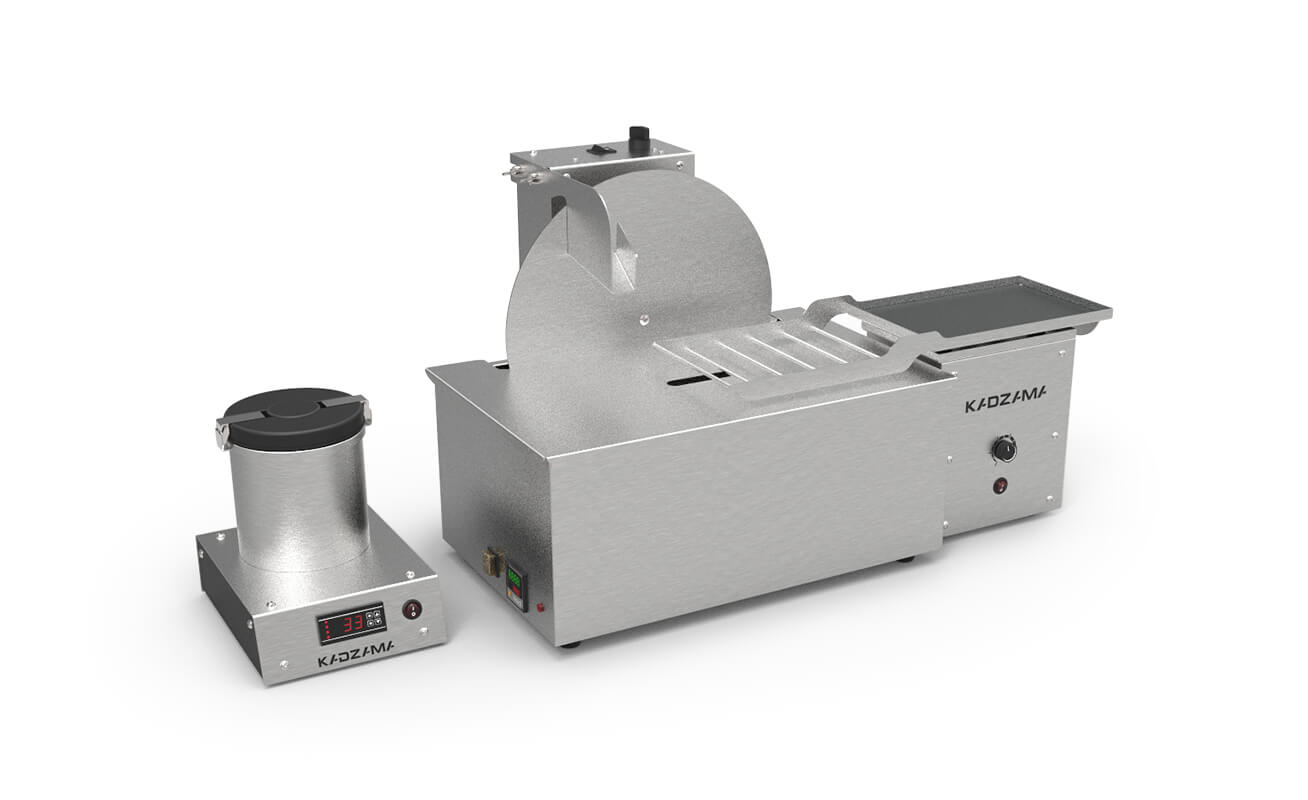
The full standard price of the kit is €4,270. The current package offer is €3,490 for the complete mini-factory.
That price matters because it changes the launch threshold. Instead of building around industrial infrastructure first, a producer can start with a compact line, validate demand, and scale when order volume actually justifies the next step.
What production result this setup is designed to deliver
This mini-factory is intended for small-batch and craft-scale chocolate production.
The tempering machine holds up to 20 kg of chocolate in one bowl. Since melting a full batch takes approximately 4–5 hours, the realistic output depends on how the day is organized. In practice, the setup can produce around 20–60 kg per day.
The lower end of that range is just as important as the upper end. A workshop does not have to run at maximum capacity every day. If the task is a smaller batch, a pilot launch, or a custom order, production can be intentionally lower. That flexibility is part of the advantage.
The setup also runs from a standard 220V outlet. This reduces launch complexity because the business does not need to start with three-phase infrastructure just to produce molded chocolate in a controlled way.
1. The core of the line: 20 kg tempering machine with wheeled mixer

This machine is the center of the production process.
Its first job is temperature control. Instead of relying only on manual monitoring, the machine uses a controller with accuracy up to 0.1°C. That matters because chocolate is sensitive to temperature variation. If the working range shifts too much, crystallization becomes less stable, and the finished product becomes less predictable in gloss, snap, and mold release.
Its second job is controlled heating. Even wall heating with temperatures not exceeding 50°C helps avoid local overheating of the chocolate mass.
Its third job is keeping the molding stage practical. With one bowl with capacity 20 kg, and a melting time of about 4–5 hours, the machine realistically supports about 20–60 kg per day depending on the workflow.
The wheeled mixer also turns the machine into a dispensing point. Instead of filling molds manually with ladles or piping bags, the operator can work directly under controlled chocolate flow. That reduces handling time and makes the filling stage more repeatable.
2. Cocoa butter crystal incubator: stable silk for larger chocolate volumes
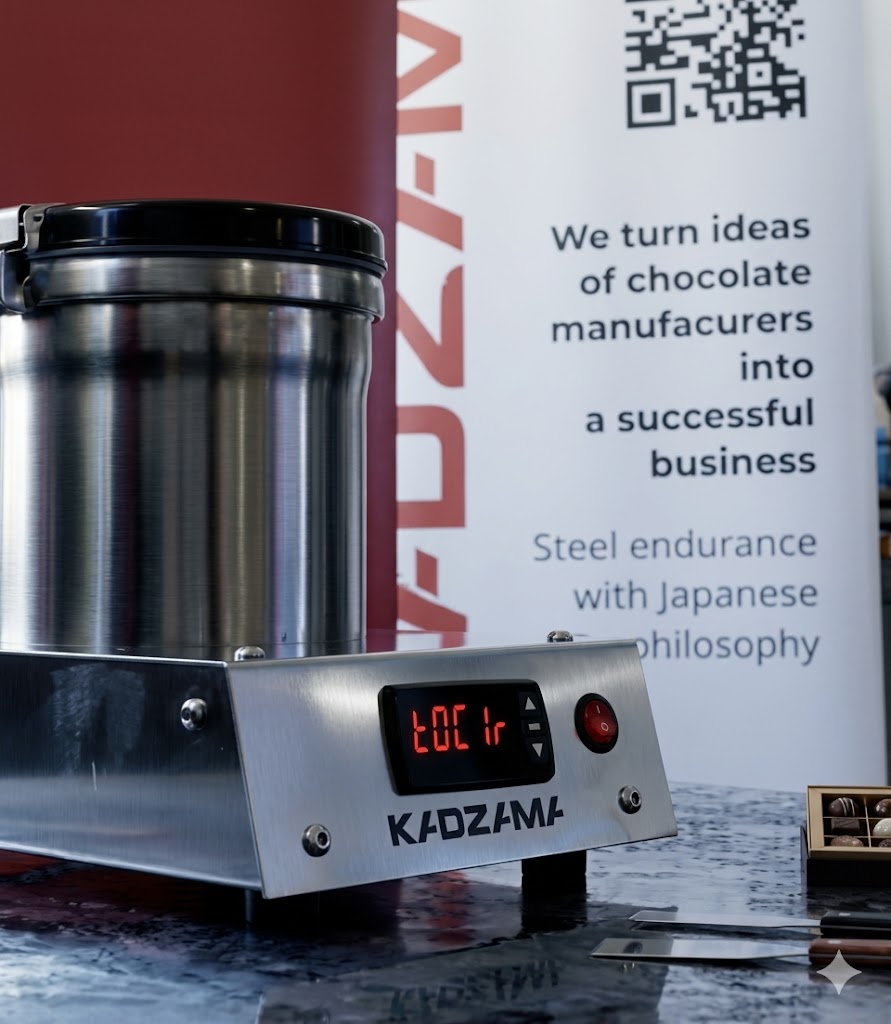
For many small producers, a fully automatic tempering machine is difficult to justify at launch. Equipment in that category often costs €10,000–€20,000 and may require three-phase power.
The incubator offers a more economical way to stabilize the tempering stage.
It produces up to 2 kg of silk in 24 hours. Because silk is added in a very small proportion, that amount is enough for up to 600 kg of chocolate.
Silk introduces stable seed crystals into the chocolate, which helps guide crystallization more predictably. As a result, the working process becomes easier to standardize and less dependent on operator timing alone.
Instead of buying ready-made crystallized additives, the producer can make silk from standard cocoa butter in-house. That gives more control over consumables and supports lower operating cost over time.
3. Vibrating table: defect reduction and more consistent finish
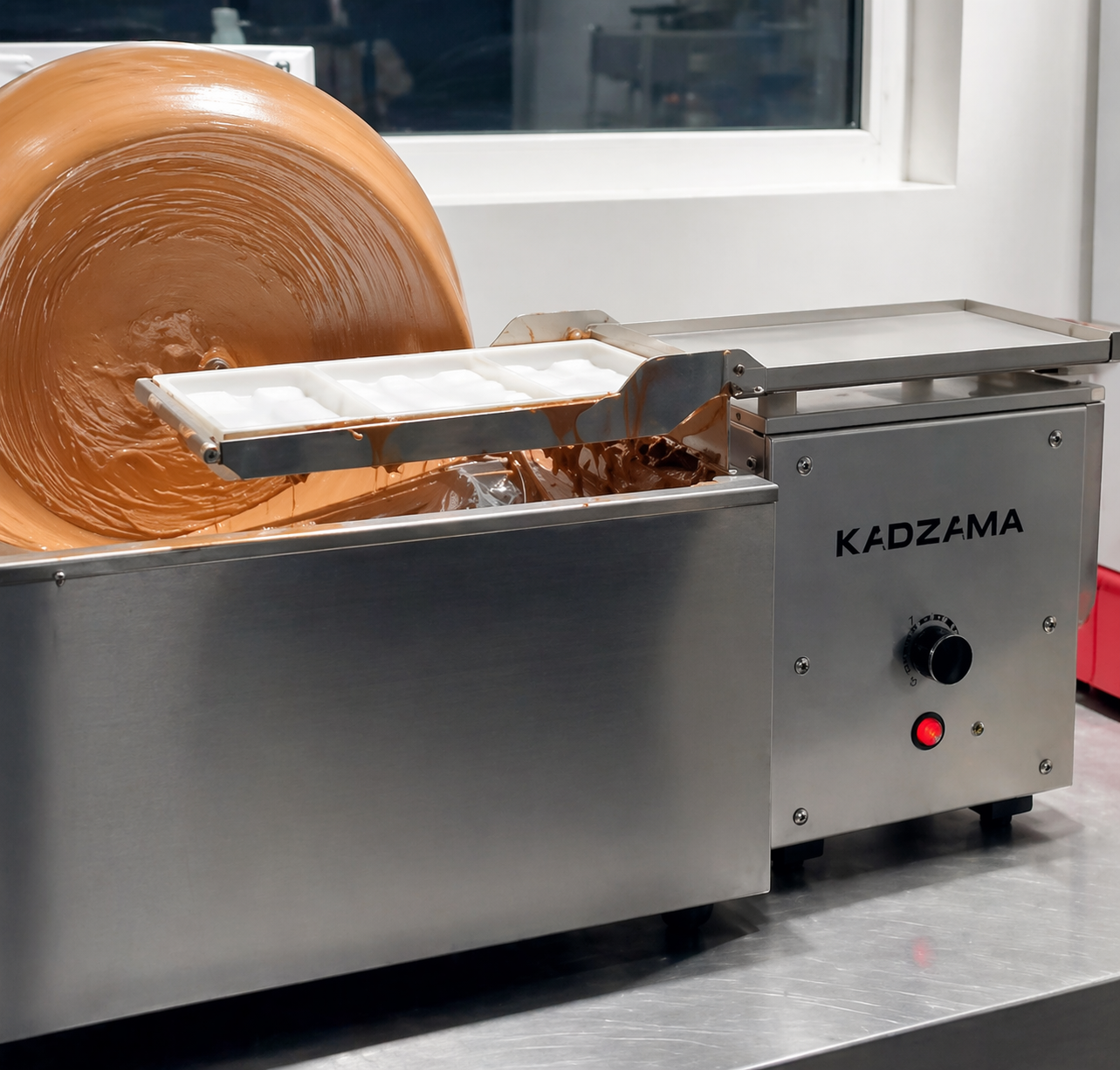
The vibrating table is a small unit, but it has a direct effect on the final product.
When chocolate is deposited into molds, trapped air and uneven distribution can create visible defects. These defects reduce visual consistency, increase rework, and make the finished product look less reliable at the point of sale.
Vibration helps remove air bubbles and level the chocolate across the mold more evenly. As a result, the surface becomes cleaner and the shape more uniform.
That affects margin, not just appearance. Fewer visible defects mean less remelting, less operator correction, and a more consistent product in the box or on the shelf.
The Kadzama vibrating table also plugs directly into the tempering machine’s socket, which helps keep the workspace compact and reduces extra infrastructure demands in a small production area.
What the investment looks like in real numbers
Let’s take a simple scenario. You melt 20 kg of dark chocolate per day and produce bars for 28 production days per month. That gives you 560 kg of finished chocolate per month.
If you use Callebaut 70-30-38 dark chocolate at about €19.50 per kg, your monthly chocolate cost is €10,920. Add about 2 kg of cocoa butter for silk at €35 per kg, and the monthly raw material cost reaches approximately €10,990.
That means the raw-material cost of finished bars is about €19.63 per kg, or about €1.96 per 100 g bar.
The mini-factory itself costs €3,490. So the economics depend on the selling price of your finished bars. In the market, dark chocolate bars range from roughly €19.50 per kg in the lower retail segment to €30–55+ per kg in premium and artisan positioning.
If your bars sell at €32.90 per kg, monthly revenue at 560 kg would be about €18,424. Against a raw-material cost of €10,990, that leaves €7,434 before packaging, labor, rent, energy, and taxes.
Important note: this is an example of a standard bar. Different products and recipes will produce different economics.
Where this mini-factory works best
- Startup chocolate brands
- Craft workshops
- Test launches and pilot batches
- Corporate and branded orders
- Seasonal product lines
- Producers who need controlled small-batch output without industrial infrastructure
In these situations, the main goal is usually not maximum automation. It is stable quality, manageable output, and a sensible cost of entry.
What this setup does not replace
This mini-factory does not remove every production limit. Total daily output will still depend on:
- Melting time
- Mold handling speed
- Cooling capacity
- Packaging pace
- Number of operators
- Product format and recipe
At larger volumes, a workshop may eventually outgrow a compact setup and move to a larger automatic tempering system. But for an early-stage producer, this mini-factory creates a practical bridge between manual work and industrial investment.
FAQ
How much chocolate can this mini-factory produce per day?
In practice, the setup supports around 20–60 kg per day, depending on product type, workflow, and how intensively the machine is used during the shift.
Can production be lower than the maximum output?
Yes. The setup does not have to run at its upper limit every day. If the workshop needs smaller batches, test runs, or custom orders, production can be lower by design.
Why is the output not stated as a fixed number?
Because real output depends on several variables: melting time, product type, operator workflow, mold handling, and the rest of the production chain. A realistic range is more trustworthy than a single theoretical figure.
How much silk does the incubator produce?
The incubator produces up to 2 kg of silk in 24 hours.
How much chocolate can that amount of silk support?
That volume of silk is enough for up to 600 kg of chocolate, because silk is added in a small proportion.
Do you need industrial power to run this setup?
No. One of the advantages of this mini-factory is that it runs from a standard 220V outlet.
 Sending...