
Can Powdered Sugar Reduce Melanger Refining Time?
How does sugar type affect chocolate refining time in a melanger?
In chocolate production, refining is one of the most important and time-consuming stages. The melanger must reduce particle size, distribute ingredients evenly in the fat phase, and create the smooth texture expected from high-quality chocolate.
While many producers focus on cocoa beans, cocoa butter, and tempering, the type of sugar used can also have a significant impact on refining efficiency.
One common question among chocolate makers is:
Can powdered sugar speed up refining in a melanger compared with granulated sugar?
The short answer is:
Yes, powdered sugar can reduce melanger refining time by approximately 10–20%, but only when it is completely dry. If powdered sugar absorbs moisture, it can increase viscosity and slow down the refining process instead.
Understanding how sugar particles behave inside a melanger helps producers improve efficiency, reduce production time, and achieve more consistent chocolate quality.
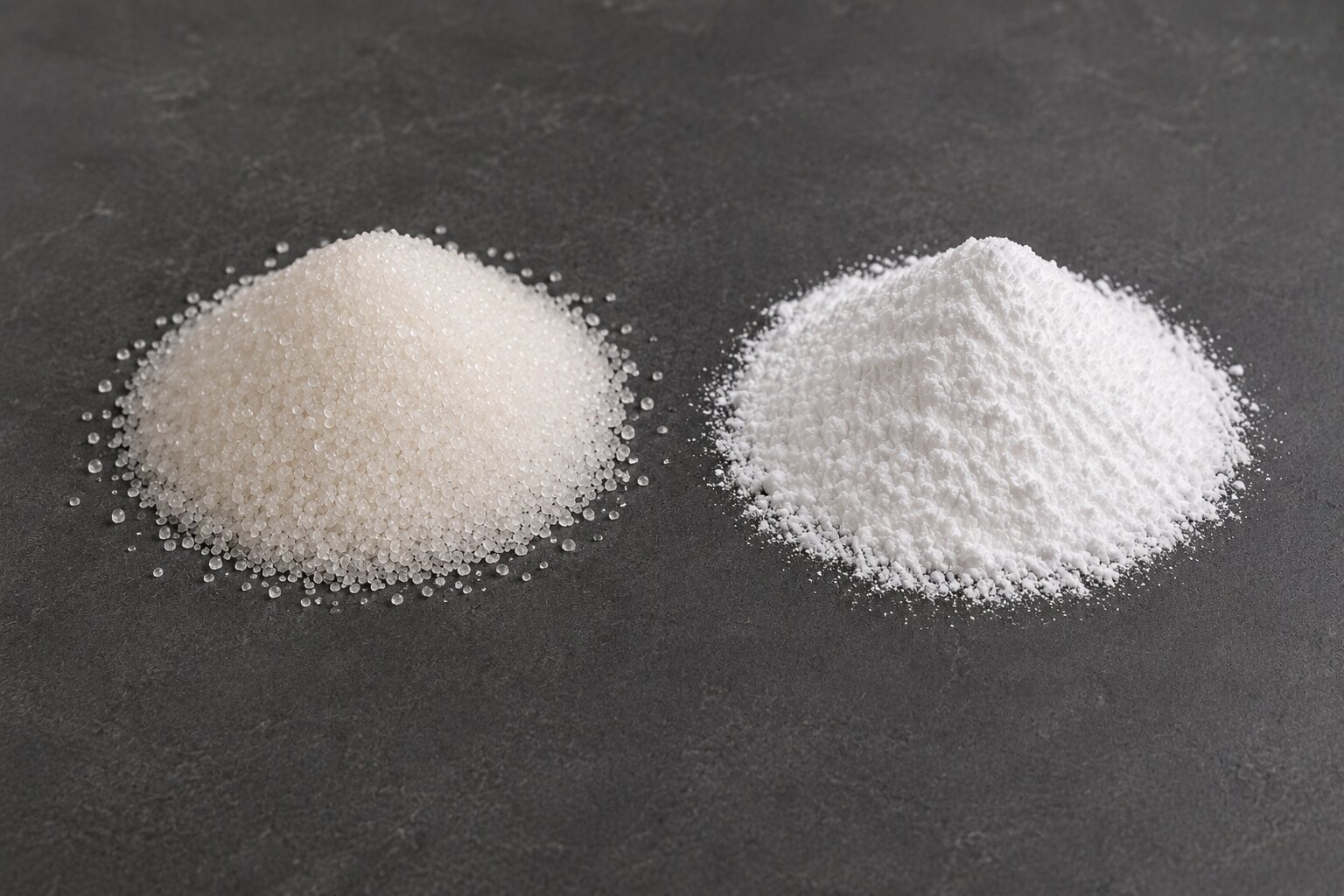
Why sugar particle size matters in a melanger?
A melanger works through continuous friction, shear, and compression between rotating granite stones and the stone base.
During chocolate refining, the melanger performs several essential tasks:
- Reduces particle size of sugar and other solids
- Distributes ingredients evenly throughout cocoa butter or other fats
- Creates a smooth chocolate texture
- Improves mouthfeel by reducing gritty particles
For most chocolate and nut-based products, the target particle size is below 20–25 microns to achieve a smooth sensory experience.
The starting particle size of sugar directly affects how long the refining process takes.
Large sugar crystals require more mechanical work before the chocolate reaches the desired texture.
Why does granulated sugar take longer to refine?
Traditional granulated sugar usually has crystal sizes of approximately 450–600 microns.
Because these crystals are relatively large, the melanger must spend significant time breaking them down into smaller particles.
This leads to:
- Longer chocolate refining cycles
- Higher energy consumption
- Increased mechanical workload on the melanger
- Greater wear on granite stones
Typical refining time:
| Sugar type | Starting particle size | Average refining time |
| Granulated sugar | 450–600 microns | 18–24 hours |
| Powdered sugar | 50–100 microns | 14–20 hours |
Actual refining time depends on:
- Melanger capacity
- Stone pressure
- Recipe composition
- Fat content
- Desired final particle size
For small-scale chocolate makers, reducing several hours from each batch can significantly improve production efficiency.
How does powdered sugar improve chocolate refining efficiency?
Powdered sugar is already mechanically processed into much smaller particles before entering the melanger.
Because of this, the melanger spends less time reducing sugar crystal size and can move more quickly toward:
- Homogenization
- Texture development
- Final particle refinement
This is why many chocolate makers consider powdered sugar as a potential way to shorten refining time.
Using dry powdered sugar may provide:
- Faster refining cycles
- More efficient use of melanger operating time
- Lower mechanical stress on grinding stones
- Improved production consistency
However, powdered sugar is not always a universal solution.
Its effectiveness depends on the entire chocolate recipe and production process.
When does powdered sugar not reduce refining time?
Although powdered sugar can improve efficiency, it does not always create a significant time reduction.
Other ingredients may determine refining speed
In many chocolate and spread formulations, sugar is not the hardest ingredient to refine.
The total refining time may be controlled by:
- Cocoa particles
- Milk powder
- Nuts
- Seeds
- Alternative sweeteners
If these ingredients require more mechanical processing than sugar, switching from granulated sugar to powdered sugar may have only a minor effect.
Additional refining equipment can reduce the advantage
If chocolate production includes additional refining equipment, such as:
- Ball mills
- Five-roll refiners
- Industrial particle reduction systems
the advantage of starting with smaller sugar particles becomes less important.
The overall production process should always be evaluated rather than focusing only on one ingredient.
The moisture problem: why wet powdered sugar can slow chocolate production?
The biggest challenge when using powdered sugar in chocolate production is moisture absorption.
Powdered sugar is highly hygroscopic, meaning it readily absorbs moisture from the surrounding environment.
Even very small amounts of absorbed water can significantly change how chocolate behaves inside a melanger.
In fat-based systems such as chocolate, water partially dissolves the outer layer of sugar crystals. The dissolved sugar forms thin, highly concentrated syrup films that bind adjacent particles together, creating microscopic capillary bridges. These bridges dramatically increase the apparent viscosity of the chocolate mass and restrict its ability to flow freely.
As viscosity increases, circulation beneath the granite stones is reduced. Less chocolate mass passes through the grinding zone with each rotation, decreasing refining efficiency despite the smaller initial particle size of the powdered sugar. In other words, although the sugar starts finer, the melanger processes less material over time because the thickened mass moves more slowly through the refining area.
As a result:
- The chocolate mass becomes thicker
- Circulation inside the melanger is reduced
- Grinding resistance increases
- The granite stones must work harder to move and refine the mass
- Overall refining time increases instead of decreasing
Instead of improving production efficiency, moist powdered sugar can make the chocolate mass dense and difficult to circulate, offsetting the advantage of its smaller particle size.
For this reason, moisture control is one of the most important factors when using powdered sugar in chocolate production.
How to store powdered sugar for chocolate production?
Proper storage is essential to maintain powdered sugar performance.
Recommended practices:
- Store powdered sugar in airtight containers
- Keep containers away from heat and humidity
- Use desiccants such as silica gel when appropriate
- Maintain production room humidity below 50%
If powdered sugar has absorbed moisture, gentle drying may help restore its processing properties.
For example, drying at approximately 50°C for several hours may improve flowability, depending on batch size and available equipment.
The goal is not to modify the sugar chemically but to restore stable processing conditions.
How to add powdered sugar to a melanger correctly?
The method of adding powdered sugar can also affect refining efficiency.
Adding all powdered sugar at once may create dry clusters and sudden increases in viscosity.
A better approach is:
- Allow cocoa butter or fat to become fully liquid
- Start circulation of cocoa solids or other ingredients
- Add powdered sugar gradually
Gradual addition helps:
- Improve sugar particle wetting
- Prevent dry agglomerates
- Maintain better circulation
- Reduce viscosity spikes during early refining
This simple adjustment can improve both processing stability and final texture.
Does powdered sugar without anti-caking agents work better?
Many commercial powdered sugars contain anti-caking agents to prevent clumping.
Common additives include:
- Corn starch
- Tricalcium phosphate
- Silicon dioxide
These ingredients are generally used in small amounts, but they may slightly affect:
- Chocolate viscosity
- Texture
- Mouthfeel
- Processing behavior
For premium chocolate production, many manufacturers prefer powdered sugar without anti-caking additives whenever possible.
Powdered sugar vs alternative sweeteners in a melanger
Different sweeteners behave very differently inside a melanger, making recipe development far more challenging than simply replacing one sweetener with another. Their behavior depends not only on sweetness but also on particle size, crystal structure, hardness, moisture sensitivity, hygroscopicity, and interaction with fats.
For example:
Coconut sugar
May have softer particles and can refine faster mechanically.
Often contains higher natural moisture, which may increase viscosity during refining.
Erythritol
Has very hard crystals.
May remain gritty unless it is micronized before refining.
Allulose
Can behave similarly to sucrose in terms of flow.
Is also sensitive to moisture and requires careful handling.
As a result, two sweeteners with similar sweetness can produce completely different refining times, viscosity profiles, processing behavior, and final chocolate textures.
To help manufacturers predict these differences, we developed a practical guide for working with sugars and sugar substitutes in chocolate production.
The guide helps you:
Compare the technological behavior of the most common sugars and sweeteners—not just their sweetness.
Select the right sweetener based on refining performance, viscosity, texture, and processing stability.
Understand common challenges such as hygroscopicity, long refining times, cooling effect, and recipe balance before they become production problems.
Develop sugar-free and reduced-sugar recipes with fewer trial batches, saving both time and ingredients.
Learn formulation strategies for different sweetener systems, including blends and bulk sweeteners.
Calculate equivalent sweetness using the included Sweetness Index Calculator, making recipe conversion faster and more predictable.
Download the guide here: sweeteners & substitutes
Best practices for using powdered sugar in a melanger
To maximize the benefits of powdered sugar:
- Use only completely dry powdered sugar
- Store it in airtight conditions
- Protect it from humidity exposure
- Check whether anti-caking agents are present
- Add powdered sugar gradually during refining
- Dry powdered sugar if moisture absorption is suspected
- Compare refining times across several production batches
Tracking actual production data is the best way to determine whether powdered sugar improves efficiency for a specific recipe and melanger setup.
Final recommendation: should chocolate makers use powdered sugar?
Powdered sugar can be a practical tool for reducing refining time in a melanger, especially for small and medium-scale chocolate production.
When it is:
- Dry
- Properly stored
- Added correctly
it can shorten refining cycles and reduce unnecessary mechanical workload.
However, moisture completely changes its behavior. Wet powdered sugar can increase viscosity, reduce circulation, and slow production.
The best approach is not simply choosing powdered sugar over granulated sugar, but understanding how each ingredient behaves inside the melanger.
For chocolate makers looking to improve efficiency, the key factors are:
particle size + moisture control + correct processing technique.
When these conditions are controlled, powdered sugar can become an effective tool for faster and more consistent chocolate refining.
 Sending...