
When Size Matters: Why Bigger Stones Matter in a Chocolate Melanger
When choosing a chocolate melanger, it's easy to focus on bowl capacity. But fitting 35 kg of chocolate into a machine is one thing. Refining all 35 kg efficiently is another.
The real work happens between the granite stones and the bottom of the bowl. And that's where size matters.
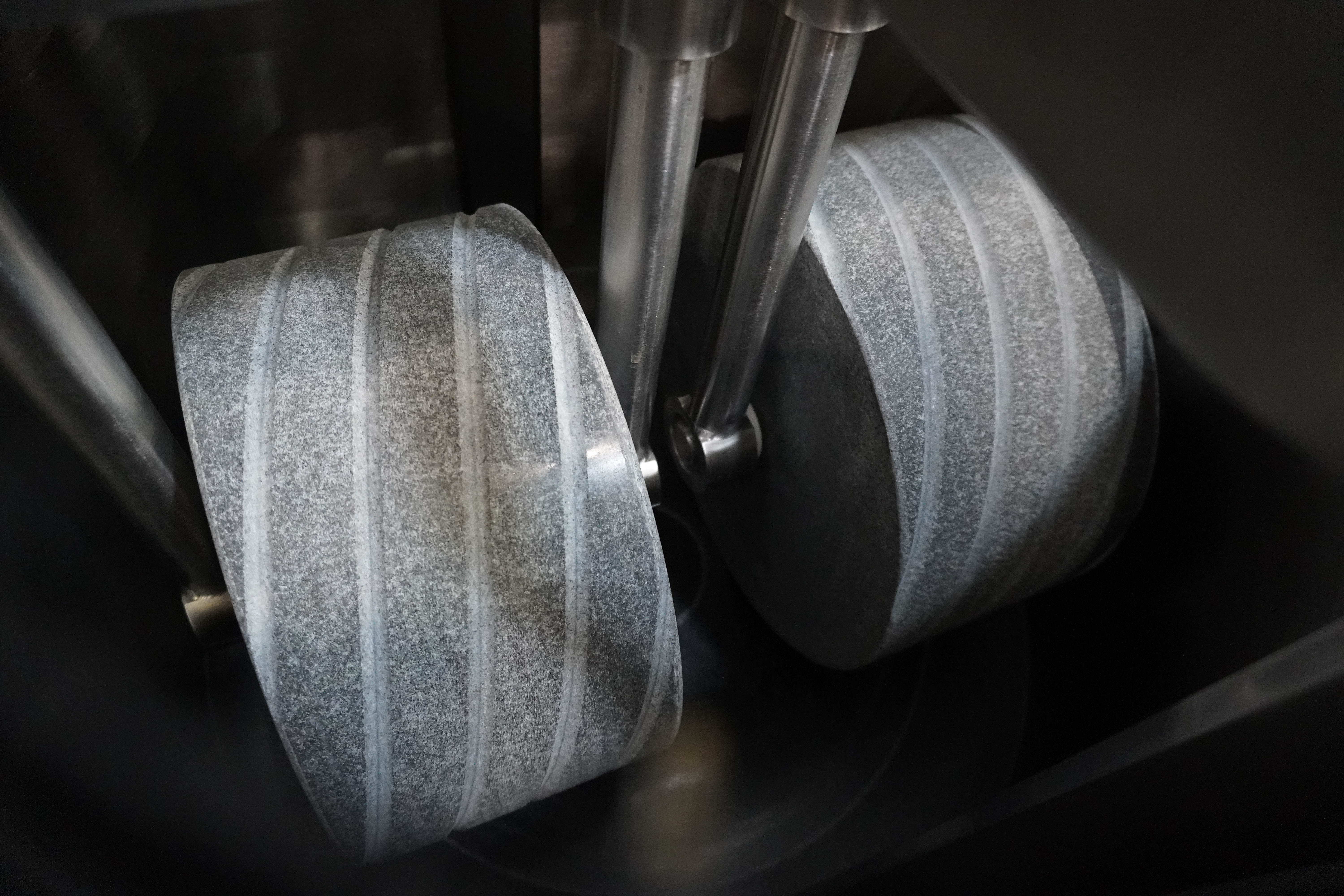
A Little Physics Behind the Grinding
A melanger works through two main mechanical actions:
- Compression – the stones apply force to crush solid particles of cocoa, sugar and nuts.
- Shear – relative movement between the stones, particles and bowl helps break down particles and disperse them throughout the mixture.
Larger stones can provide a wider grinding zone, allowing more material to be processed as the mixture circulates. Their greater mass can also contribute to the downward grinding force.
But there's an important detail.
The basic physics:
If the contact area increases without a corresponding increase in force, the average pressure actually decreases.
That's why simply making the stones bigger isn't enough. Their weight, shape, pressure and movement must work together.
In practice, the forces acting on individual particles are more complex than this simplified formula. The actual contact conditions depend on stone geometry, the material being refined and the grinding mechanism.
How Does Stone Size Affect the Finished Chocolate?
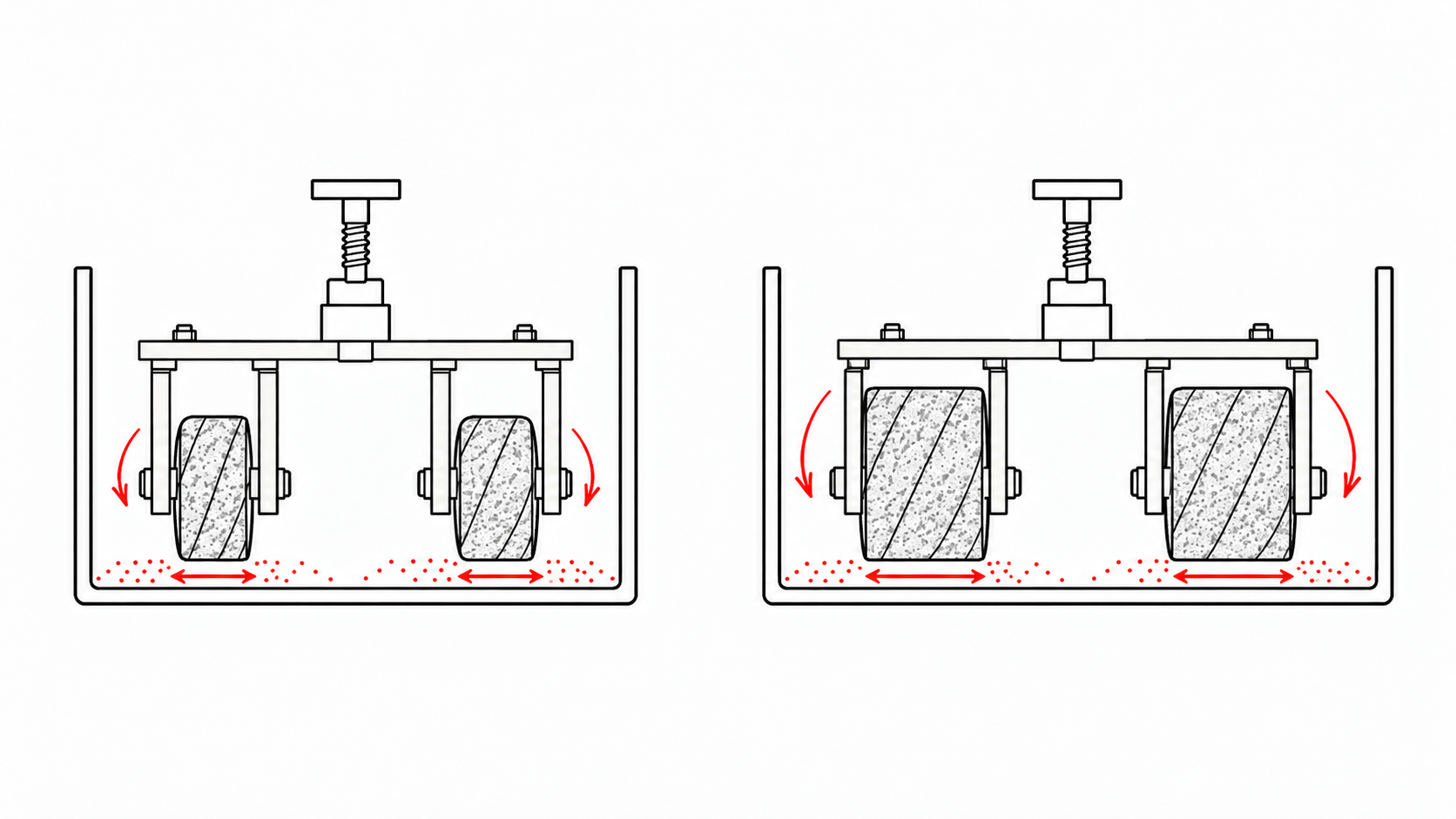
With the right stone geometry and grinding pressure, a melanger can achieve:
- Effective refining of larger batches. A suitably sized grinding zone helps process the material as it repeatedly circulates through the machine.
- A smoother texture. Repeated grinding reduces coarse particles that create a gritty mouthfeel.
- Consistent results. A properly designed grinding system helps the entire batch reach the required fineness.
For fine chocolate, producers commonly aim for particle sizes around 15–25 microns, although the ideal target depends on the recipe, particle size distribution and desired texture.
What Does Science Say?
A study by Tan and Balasubramanian (2017), published in the Journal of Food Engineering, investigated chocolate refining with conical and cylindrical stone rollers.
The researchers found that both configurations delivered broadly similar refining performance, but differences in particle shape appeared during the early stages of grinding.
Other research has also examined how melanger operating conditions influence particle size reduction and chocolate quality.
In other words, it's not just how big the stones are, but how effectively they work.
The Bottom Line
A bigger bowl doesn't automatically mean better grinding. And bigger stones alone don't guarantee faster refining.
What matters is having a grinding system designed to handle the full batch efficiently.
Because it's not just about how much chocolate your melanger can hold. It's about how well it can refine it.
Frequently Asked Questions
Do bigger melanger stones refine chocolate faster?
Not necessarily. Larger stones can provide a wider grinding zone, but refining speed also depends on stone geometry, grinding pressure, rotation speed, batch size and recipe.
How does stone size affect chocolate texture?
Stone dimensions influence the grinding contact area and how particles are processed. With suitable pressure and movement, the stones reduce coarse particles, helping achieve a smoother chocolate texture.
What matters more: bowl capacity or grinding stone size?
Both must be considered together. Bowl capacity determines how much product a melanger can hold, while stone geometry, pressure and movement influence how effectively that product is refined.
Scientific References
- Tan, J. & Balasubramanian, B. M. (2017). Particle size measurements and scanning electron microscopy (SEM) of cocoa particles refined/conched by conical and cylindrical roller stone melangers. Journal of Food Engineering, 212, 146–153. Read the research .
- Hinneh, M. et al. (2019). Applicability of the melanger for chocolate refining and Stephan mixer for conching as small-scale alternative chocolate production techniques. Journal of Food Engineering, 253, 59–71. Read the research .
- Cooney, J., Kennedy, T., Monteiro, L. & Martini, S. (2024). Flow properties of single origin chocolates: Effect of product formulation and particle size. Journal of Food Science, 89, 4419–4429. Read the research .
 Sending...